
An ignorant question leads Dr. King to offer a strong lesson in black history in two minutes flat. I can tell that he’s slightly irritated, but also determined to break it ALL the way down. Which he does brilliantly. A king. #MLK90 pic.twitter.com/YJvvv4X22N
— Ava DuVernay (@ava) January 21, 2019
MLK offers a history lesson
January 23rd, 2019 · No Comments
→ No CommentsTags: General
Hiatus
January 4th, 2019 · No Comments
Abandoned this blog in the fall of 2015, toward the end of my tenure as a professor of American studies and EFL classes for Japanese university students here in Miyazaki. Still in the game, though now as a part-time lecturer, & still in the struggle to teach and learn with my students, but as an ostensible retiree. Can’t stop: in fact, need to re-ground, try again, learn new rules, and adopt new practices.
‘The challeng of tomorrow is directly related to whether all of the children of this planet can realize their potential – and this cannot happen unless each child is able to dream “those great dreams” that motivate dynamic participation.’
Anthony Braxton
Tri-axium Writings 2, p 197
quoted in Lock, G. Forces in Motion 30th Anniversary Edition,(1988, 2018), p 7
→ No CommentsTags: General
Homecoming Day at MMU, 7 November 2015
November 6th, 2015 · No Comments
This Saturday, 7 November 2015, I am giving a talk for members of our MMU alumnae association on “Liberal Arts and Lifelong Learning.”
→ No CommentsTags: General
Sotsuron in English ~ challenges and possibilities
May 18th, 2013 · No Comments
Presenting in a forum with Joe Tomei, Ken Ikeda, and John Herbert at PanSIG13 on Sunday, 19 May. We’ll be discussing the pleasures and puzzles of advising students enrolled in senior seminars who write their graduation theses in English. For anyone interested, I’ve uploaded my handout for downloading.
→ No CommentsTags: teaching
Brooklyn Babylon
April 26th, 2013 · No Comments
Listening to ‘Brooklyn Babylon,’ Darcy James Argue’s stunning new album from New Amsterdam Records on NPR’s First Listen.
→ No CommentsTags: music
IATEFL 2013, Liverpool, UK, 8-12 April
April 3rd, 2013 · No Comments
Next week the city of Liverpool hosts the IATEFL conference. If you cannot attend, but are interested in language learning and teaching, click on the banner below to access the video feeds from the conference.

→ No CommentsTags: General
Rattapallax 21
April 3rd, 2013 · No Comments
The latest issue of Rattapallax, Rattapallax21, has just been released as a free iPad app. It’s great! So, if you’ve got an iPad and are interested in poetics and new writing, in new modalities, check it out. (The link points to the US iTunes store, but the magazine should be available through iTunes everywhere, as I’ve just downloaded it here in Japan.)
→ No CommentsTags: poetics
Music tonight in New York
April 3rd, 2013 · No Comments
Wishing, at least today/tonight (2 April EDT), it could be April in New York for me. The Jim Rotondi Group with leader Jim Rotondi, Trumpet, Mike DiRubbo, Alto Sax, David Hazeltine, Piano, David Wong, Bass, and Joe Farnsworth, Drums is playing at Smalls. Over in Brooklyn, Eri Yamamoto’s trio played at Roulette – and that’s just scratching the beat surface.
If you’re not in New York, check out a subscription to Smalls Jazz Club’s streaming services.
→ No CommentsTags: music
Upgrading to Lion
July 21st, 2011 · No Comments
Giddy at midnight, still giddy at first light: the upgrade to Lion, Mac OS 10.7, was a rib-tickling kick from start to finish, and put a feather in the cap of an already very happy day, at least for those with geeky tendencies, for had already updated BBEdit and Tinderbox. I had also read a few pre-release musings about how the download and install process would go, and my end-user experience was pure joy, especially once the install splash screen announced the completion of the download: the MGM Lion tamed. To Steve Jobs and his fellow designers/programmers, kudos and huzzahs! The Lion in cameo against a white background; could anyone have designed a more minimalist and elegant confirmation of Brenda Laurel’s Computers as Theatre? Yee-haw.
→ No CommentsTags: General
Maid as Muse Review at X-Poetics
May 5th, 2010 · No Comments
Robin Tremblay-McGaw has a great little review of Aífe Murray’s Maid as Muse: How Servants Changed Emily Dickinson’s Life and Language (2010). The review includes a generous selection of extended quotes from Murray’s text, giving readers a good sense of the pleasures in Ms. Murray’s prose. Murray has made the working poor of nineteenth century Amherst visible, showing the ways in which their contributions to the Dickinson household economy not only enabled ED’s artistic independence but created the linguistic and social bases from which Ms. Dickinson’s poetic experiments grew. A must read, which gives a critical reading to the conventional notion of the artist as isolated genius:
That ‘social text,’ that fleshy real world was inhabited by maids, laundry workers, seamstresses, blacksmiths, tinsmiths, basket weavers, laborers, stablemen–all of whom Emily knew by name. The poet may have traded on stereotypes (what Folsom and Price call vortex words) that telegraphed charged images to her readers. What’s to be made of Emily’s relationships to the people behind these stereotypes? This was the social context of her art-making, the whole roster of people who make the work possible and ‘fuel the fantasy of independence. Ironically, it is this very support that allows the practice of art making to appear as the ultimate expression of individual freedom.
To learn more, see Aífe Murray and her work, see her Maid as Muse web site.
Murray, Aífe. Maid as Muse: How Servants Changed Emily Dickinson’s Life and Language. Durham: University of New Hampshire Press, 2010.
→ No CommentsTags: poetics
Making it, full time
March 19th, 2009 · No Comments
On March 6, Bill Moyers’s Journal celebrated poetry. The elegy for the Dodge Poetry Festival, cancelled for 2010, was excerpted from Fooling With Words produced in 2000. The segment features readings shorter and longer, including Kurtis Lamkin, Sharon Olds, W.S. Merwin and Coleman Barks. Lamkin performs with the kora, while Barks’s concluding reading features a hauntingly beautiful piano, cello, percussion and oboe accompaniment. The Oregon Literature Review site hosts another online video of Kurtis Lamkin; Coleman Barks’s home page has a shop section, offering a number of titles in a variety of formats.
→ No CommentsTags: poetics
Reading John Hersey’s “Hiroshima”
August 13th, 2008 · No Comments
I have just finished reading Steve Rothman’s account of the publication of Hersey’s “Hiroshima,” which I also finished reading today. I have two copies of Hersey’s text in my library, the version published in the 1988 reprint of Here to Stay, a collection of Hersey pieces originally published in The New Yorker and in Life, and the digitized version available on the DVD version of The New Yorker. The print version has all the practical versions of the codex book, easy to read in bed, etc. to pick up and put down as the practical necessities of life take precedence over reading time, while the digitized version gives one a copy of the full text of the 31 August 1946 issue of the magazine. The New Yorker issue of 31 August 1946 was devoted in its entirety — with the notable exception of the columns and pages given over to advertisements — to Hersey’s piece. Hersey’s much praised tone — objective, understated, and sober — is luminous and pure, and stands in ironic contrast to celebrations of wealth and taste in the ads, which would appeal to the The New Yorker’s upper-crust readership: the educated and well-heeled readers who have the leisure to think carefully about the morality of government policy and to shop at Lord & Taylor’s, Tiffanys, and and Bergdorf-Goodman.
“The Publication of “Hiroshima” in The New Yorker,” was written as a term paper for a graduate course on science and society at Harvard in 1997, and contains a very useful overview of the publication and reception of the original version. There are a number of links to related pieces on Rothman’s home page, including one to Terrorism, War, and the Press, a 2003 collection edited by Rothman’s wife, clearly of immediate interest as the war in Iraq drags on, and politicians continue to beat the drums of war. Consider, for example, McCain’s latest pontifications on democracy and so-called U. S. interests in relation to the current crisis in Georgia.
The main questions, as always, reverberate: What must be done? When will we ever learn?
→ No CommentsTags: General
Writing Across the Curriculum
July 24th, 2008 · No Comments
The end of the term provokes reflection. What have I done well with my classes? Where did I go wrong? In what ways do I need to change my approach to the teaching of writing, design of assignments, construction of more useful learning environments for my students? Toward those ends, I began to take a look at resources available online, and am very pleased to see what’s happened at The WAC Clearinghouse.
The site now hosts several online journals, most usefully, Across the Disciplines, and a collection of digitized books discussing the teaching of writing, writing across the curriculum pedagogies, and reference guides to rhetoric and composition studies.
In addressing the needs of my students here in Miyazaki, I need to find a similar resource in Japanese addressing academic skills and the development of expertise as a writer in the L1.
→ No CommentsTags: teaching
Ronald Johnson: Life and Works
July 21st, 2008 · No Comments
In Hurrah for Euphony!, Mark Scroggins shares his delight upon taking delivery of Ronald Johnson: Life and Works, just published by the National Poetry Foundation in Orono, ME. Scroggins describes the volume as containing 700 plus pages of critical cool. Hope I can steal some time for it later this summer.
→ No CommentsTags: poetics
Jacket 36
July 20th, 2008 · No Comments
Jacket 36, the late 2008 issue, is taking form. It includes a discussion between Rachel Blau DuPlessis and William Watkin on “Draft 33: Deixis” and Watkin’s essay “Though we keep company with cats and dogs”: Onomatopoeia, Glossolalia and Happiness in the work of Lyn Hejinian and Giorgio Agamben. I am not familiar with W. Watkin’s work, but am inspired by his perspectives on contemporary literature and literary criticism. Watkins is co-coordinator of Archive of the Now, a wondrously rich collection of contemporary writers’ works: confirmation if any is still needed of what an important role the web now plays in making poetics and poetry resources available, no matter our geographic location.
→ No CommentsTags: poetics
Seminar Presentations
February 11th, 2008 · No Comments

My American Studies seminar students finished their graduation thesis presentations yesterday. I am very proud of what they achieved. Their topics included Ralph Ellison’s Invisible Man, Alice Walker’s The Color Purple and Zora Neale Hurston’s Their Eyes Were Watching God, Toni Morrison – Sula and Beloved, Ellison’s Invisible Man and Stowe’s Uncle Tom’s Cabin, Fitzgerald’s The Great Gatsby, Hemingway’s The Sun Also Rises, A Farewell to Arms, and For Whom the Bell Tolls, Langston Hughes – The Ways of White Folks and Not Without Laughter, Truman Capote’s life and works, Chang Rae Lee’s Native Speaker, Ann Tyler’s Dinner at the Homesick Restaurant and The Amateur Marriage, and Edith Wharton’s The House of Mirth and The Age of Innocence.
→ No CommentsTags: teaching
LifeTime Session 16 Nov 2007
November 17th, 2007 · No Comments
Katsuki Yasuno (vocals and euphonium) and Onishi Yosuke (piano) played at LifeTime last night with special guests. 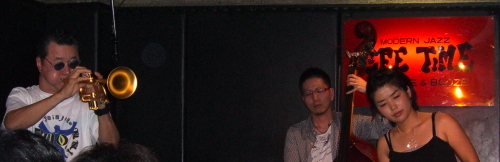
→ No CommentsTags: music
Acapella: RobStar Lobster
October 21st, 2007 · No Comments
Attended a live performance by RobStar Lobster tonight. “Donny,” (Kotaro-kun) the second vocalist in the group is the son of one of my oldest friends in Miyazaki, Yano Yasuhiro. RobStar Lobster is an acapella group performing polished and moving covers of Stevie Wonder, Beatles, Carole King songs along with Japanese pop standards and a few originals. My preferences for jazz are pretty strong, but this group of young singers put on a great show, and did a great job of highlighting the wonders of the human voice. I especially liked their mic-less version of “What a Wonderful World” they performed as an encore.
Many of the audience are folks I’ve known almost my entire stay in Miyazaki, so lots of hisashiburi (Haven’t seen you in a long time!) sociability, and the strange mix of wonder and familiarity that seeing your friends’ children growing up and finding themselves as adults provokes.
→ No CommentsTags: music
Pity the poor president!
September 3rd, 2007 · No Comments
Two pieces on Dead Certain. Read ’em ‘n’ weep . . . .
Jim Rutenberg in The New York Times.
Ed Pilkington in The Guardian.
→ No CommentsTags: General
Zadie Smith on Zora Neale Hurston
September 3rd, 2007 · No Comments
In the spring of 1969 when I was about to graduate from high school, Dr. King had been gone for a year, black power was in its ascendency (and in the FBI’s sights as we would learn all too well in December of that year. To remember it as a time of many troubles sounds/feels trite now, but important texts were being re-published, including Kate Chopin’s The Awakening, Jean Toomer’s Cane, and Their Eyes Were Watching God. My first real exposure to Hurston was attending the performance of TEWWG by a small black theater company in D. C., and I’ve been reading and re-reading the novel ever since, teaching it, and recommending it to my American Studies students as a senior research topic. For Japanese undergraduates the dialect is a challenge, but the writing is so good in so many ways it’s worth the challenge, for them and for me.
In this weekend’s Books section of The Guardian Zadie Smith has one of the most moving and thoughtful essays on the book I’ve read: “What does soulful mean?”.
Jonathan Derbyshire’s review of Mark Edmundson’s new book on Freud, and Paul Laity’s interview with Eric Hobsbawm good, too.
→ No CommentsTags: General